Mathematics
It is impossible to be a mathematician without being a poet in soul.
- Sofia Kovalevskaya.
Mathematics is the study of order, relation and pattern. From its origins in counting and measuring, it has evolved in highly sophisticated and elegant ways to become the language used to describe and explore the whole of the physical world. Statistics is the study of ways of collecting and extracting information from data, and the methods of using the information to describe and make predictions about the world around us. Together, mathematics and statistics provide a framework for thinking, solving problems and a means of communication that is concise, precise, logical and ultimately, powerful.
Believe, Achieve, Exceed:
In Maths, we contribute to the BELIEVE curriculum by addressing SMSC/BV and Careers within different topics. For example, each Unit of work begins with a discussion where we look at the potential uses of the ideas in that topic in the workplace; every lesson includes a question relating to a career which utilises that lessons learning. Maths contributes to the ACHIEVE curriculum by being a core subject. We ensure that all our KS4 pupils are able to study Maths at GCSE level. We also offer Functional Skills Maths as an additional opportunity to achieve a nationally recognised qualification in both Years 10 and 11. Finally we contribute to the EXCEED curriculum by developing problem solving skills and exposing students to the connections between mathematics and other areas, such as the sciences and the arts.
KS3:
We recognise that our KS3 provision has pupils beginning and finishing at different times. Thus, we have a rolling programme that focuses on foundational concepts and common gaps in understanding as well as introducing our pupils to how maths can be used in careers and other areas, such as science and art. The programme is flexible and is adapted where needed to the pupils we have at a given time. In addition, we improve the arithmetic ability of pupils, especially their times tables. Scaffolding and extension are incorporated where appropriate, and topics relate to the following key areas of mathematics: Number, Algebra, Statistics, Probability and Shape and Space.
KS4:
There are two foci for our KS4 pupils: GCSE Mathematics and Functional Skills Mathematics. Many of our pupils have had poor experiences with Mathematics prior to joining MMAP. They need increased support and motivation as a result.. Due to the similarity in skills between GCSE and Functional Skills Mathematics, overlapping the qualifications is beneficial to our pupils so that they reduce their Mathematics related anxiety and achieve their best possible outcomes. Class work can be scaffolded to support those doing either GCSE or Functional skills, whilst still following the same curriculum and lessons. Pupils who are higher tier candidates will be provided with increased extension, 1:1 support and online revision.
Year 10
|
Term 6 |
Term 1 |
Term 2 |
Term 3 |
Term 4 |
Term 5 |
|
Number and Algebra recap |
Number, Fraction, Decimals and Percentages |
Data, Graphs, Charts, Statistics, Algebra (basics) |
Inequalities, Sequences, Perimeter, Area and Volume, Plans and Elevations, Angles |
Ratio, Proportion, Probability |
Transformation, Circles |
Year 11
|
Term 6 |
Term 1 |
Term 2 |
Term 3 |
Term 4 |
Term 5 |
|
Revision (chosen through gap analysis and tailored to each student) |
Number, Fractions, Decimals and Percentages, Area, Perimeter and Volume |
Data, Graphs, Charts, Statistics, Angles |
Algebra, Inequalities, Sequences, Transformations |
Ratio, Proportion, Triangles, Probability |
Plans and Elevation, Construction, Loci and Bearings, Circles, Cylinders, Cones and Spheres, Similarity and Congruence |
Examination Information
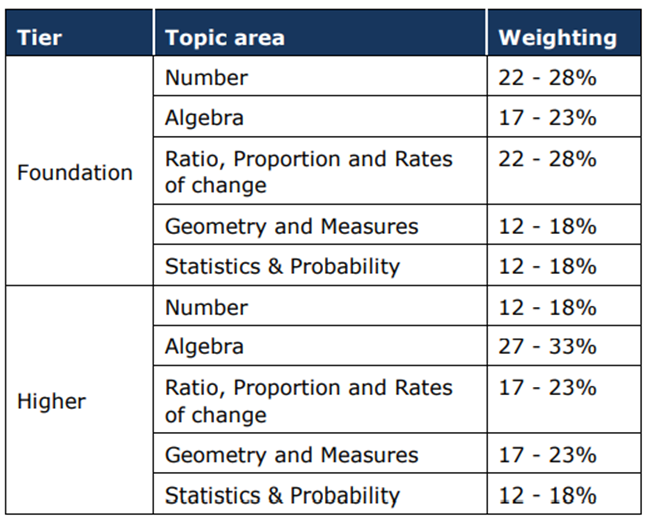
The Pearson Edexcel GCSE in Mathematics is a tiered qualification. There are two tiers – at Foundation Tier, pupils can obtain Grades 1-5 and at the Higher Tier, pupils can obtain grades 4-9. The assessment for each tier of entry consists of three externally-examined papers, all three must be from the same tier of entry. Pupils must complete all three papers in the same assessment series. Paper 1 is non-calculator and Papers 2 and 3 allow a calculator. Details of the topic distributions of the papers at each Tier are: